

Isomaltulose exerts beneficial effects on metabolic parameters that are important for the maintenance of blood glucose control, healthy body weight, and cardiovascular health. The stimulating effect of isomaltulose on the secretion of the incretin glucagon-like peptide (GLP-1) contributes to these health benefits.
Circulating levels of the gut-derived hormone GLP-1 are very low when fasting, but rapidly increase within minutes of nutrient ingestion and return to baseline within the postprandial state. It is secreted by L-cells in the distal small intestine and also in the colon. A variety of stimuli mediate the release of GLP-1 such as bile acids, fat, protein, and short-chain fatty acids resulting from the degradation of fibers. In addition, glucose increases the release of GLP-1 if it reaches the small intestinal L-cells. In a healthy body, GLP-1 regulates insulin and glucagon release, inhibits appetite, and may improve β-cell regeneration and thereby exerts advantageous effects on health.
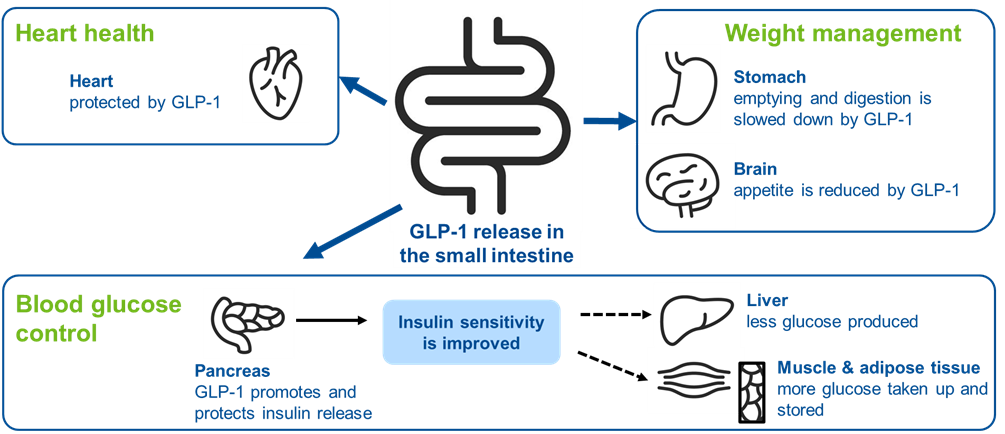
Blood glucose control
- In the pancreas GLP-1 acts on islet β-cells by promoting the production and release of insulin, inducing islet β-cell proliferation and protecting against apoptosis.
- In addition, GLP-1 exerts glucoregulatory actions via slowing of gastric emptying and glucose-dependent inhibition of glucagon secretion.
- These processes contribute to a maintenance of insulin sensitivity and thereby reduce the generation of glucose in the liver and contribute to the uptake and storage of glucose in the muscles and adipose tissue.
Weight management:
- GLP-1 slows down digestion by inhibiting the emptying of the stomach, acid release for digestive processes and the motility. These effects decrease appetite.
- GLP-1 receptors are also located in the central nervous system where GLP-1 seems to promote satiety and thereby may suppress food intake.
Heart health
- In the central nervous system, the GLP-1 receptor is also found in regions that regulate cardiovascular function.
- GLP-1 can contribute to heart health e.g. by maintaining the functioning of blood vessels and reducing blood pressure and heart rate as observed in animal models and supported by human data.
Latest Science:
Isomaltulose enhances the secretion of the incretin GLP-1 in overweight adults
A recent study led by Prof. Andreas Pfeiffer shows that isomaltulose stimulates the release of the beneficial gut hormones GLP-1 (glucagon-like peptide-1) and PYY (peptide YY) in overweight adults. This effect persists even when isomaltulose intake is followed by a complex meal one hour later. The study data confirm the beneficial effects of isomaltulose on incretins and other metabolic parameters that contribute to the maintenance of a healthy body weight, blood glucose control and cardiovascular health.
The favorable effects of gut hormones GLP-1 (glucagon-like peptide-1) and PYY (peptide YY) on metabolism including the reduction of appetite and weight gain were studied extensively and GLP-1 analogs were used for the treatment of Type 2 diabetes. Recently those drugs received attention as GLP-1 also reduces appetite and therefore contributes to weight loss. The current study adds to the solid evidence that Palatinose™ can enhance the secretion of body’s own GLP-1.
The randomized, controlled study, involving 30 overweight/obese volunteers aged 49-77 (half of them with Type 2 diabetes), compared the effects of isomaltulose and sucrose on gut hormone release. The participants’ metabolic responses were monitored over nine hours. Three hours after a standardized breakfast, they consumed a drink with 50g isomaltulose or 50g sucrose, followed by a standardized lunch one hour later. Those who consumed isomaltulose showed higher GLP-1 and PYY levels. This suggests that isomaltulose promotes gut hormone release, including GLP-1, even when consumed an hour before a complex meal.
The study’s findings are relevant for a large part of the global population, particularly older, overweight, and obese individuals, with or without diabetes. The study adds to the evidence supporting isomaltulose’s role in metabolic health, including higher secretion of gut hormones such as GLP-1 and reaffirms isomaltulose as an effective ingredient for weight and blood glucose management product developments.
The full publication is available here
References:
Baggio LL, Drucker DJ (2007) Biology of incretins: GLP-1 and GIP. Gastroenterology 132(6):2131–2157. https://www.sciencedirect.com/science/article/abs/pii/S001650850700580X
Hjørne AP, Modvig IM, Holst JJ (2022) The Sensory Mechanisms of Nutrient-Induced GLP-1 Secretion. Metabolites 12(5):420. https://www.ncbi.nlm.nih.gov/pmc/articles/PMC9147592/pdf/metabolites-12-00420.pdf.
Muskiet MHA, Tonneijck L, Smits MM, van Baar MJB, Kramer MHH, Hoorn EJ, Joles JA, van Raalte DH (2017) GLP-1 and the kidney: from physiology to pharmacology and outcomes in diabetes. Nature Reviews Nephrology 13(10):605–628. https://pubmed.ncbi.nlm.nih.gov/28869249/.
Pfeiffer AFH, Keyhani-Nejad F (2018) High glycemic index metabolic damage – a pivotal role of GIP and GLP-1. Trends Endocrinol Metab 29(5):289–299. https://www.cell.com/trends/endocrinology-metabolism/fulltext/S1043-2760(18)30046-8
Hammoud R, Drucker DJ (2023) Beyond the pancreas: contrasting cardiometabolic actions of GIP and GLP1. Nat Rev Endocrinol 19(4):201. https://www.glucagon.com/pdfs/HammoudNRE2022.pdf
Zhang J, Sonnenburg D, Tricò D, Kabisch S, Mari A, Theis S, Kemper M, Pivovarova-Ramich O, Rohn S, Pfeiffer AFH (2024) Isomaltulose Enhances GLP-1 and PYY Secretion to a Mixed Meal in People With or Without Type 2 Diabetes as Compared to Saccharose. Mol Nutr Food Res:e2300086. https://onlinelibrary.wiley.com/doi/epdf/10.1002/mnfr.202300086